At Zak Plumbing Service, we know how annoying a dripping Faucet Repairs can be. It’s not just the sound that keeps you up at night, it is the money literally going down the drain.
In 2026, with water conservation more important than ever and smart home tech becoming the norm, keeping your fixtures in top shape is a must. If you are looking to tackle some Faucet Repairs on your own, you have come to the right place.
This guide is built to help you navigate the latest 2026 plumbing standards while keeping things simple enough for a Saturday afternoon project.
The Ultimate Checklist for Basic DIY Faucet Repairs
Before you grab your wrench, you need to know what you are dealing with. Modern homes in 2026 often feature touchless sensors or eco-friendly aerators, but the mechanical “bones” of the faucet usually fall into four categories: compression, cartridge, ball, or ceramic disc.
Identifying Your Faucet Type for Faucet Repairs
- Compression Faucets: These are the old-school ones with two handles (hot and cold). They use rubber washers to stop the flow.
- Cartridge Faucets: These can have one or two handles. Instead of washers, they use a plastic or brass cartridge that moves up and down or side to side.
- Ball Faucets: Common in kitchens, these have a single handle that rotates over a ball-shaped cap.
- Ceramic Disc Faucets: These are high-quality, modern fixtures. They use two fire-hardened discs to control water, which makes them very durable.
Essential Tools for 2026 Faucet Repairs
- Adjustable Wrench: Your best friend for loosening nuts without marring the finish.
- Phillips and Flathead Screwdrivers: Needed to remove handles and decorative caps.
- Plumber’s Grease: A silicone-based lubricant that keeps O-rings from drying out.
- Hex Keys (Allen Wrench): Vital for those tiny set screws often found on modern handle bases.
- Replacement Parts: Always take your old part to the store to ensure a perfect match.
Step-by-Step Guide to Common Faucet Repairs
The secret to a successful repair is “The First Rule of Plumbing,” which is to turn off the water! Look under your sink for the shut-off valves. If they are stuck or missing, you might need to turn off the main water line to the house.
1. Fixing a Leaky Spout
If water is dripping from the end of the spout, the issue is usually deep inside. For a compression faucet, it is likely a worn-out rubber washer. For newer models, you probably need a new cartridge.
- Remove the handle decorative cap.
- Unscrew the handle and pull it off.
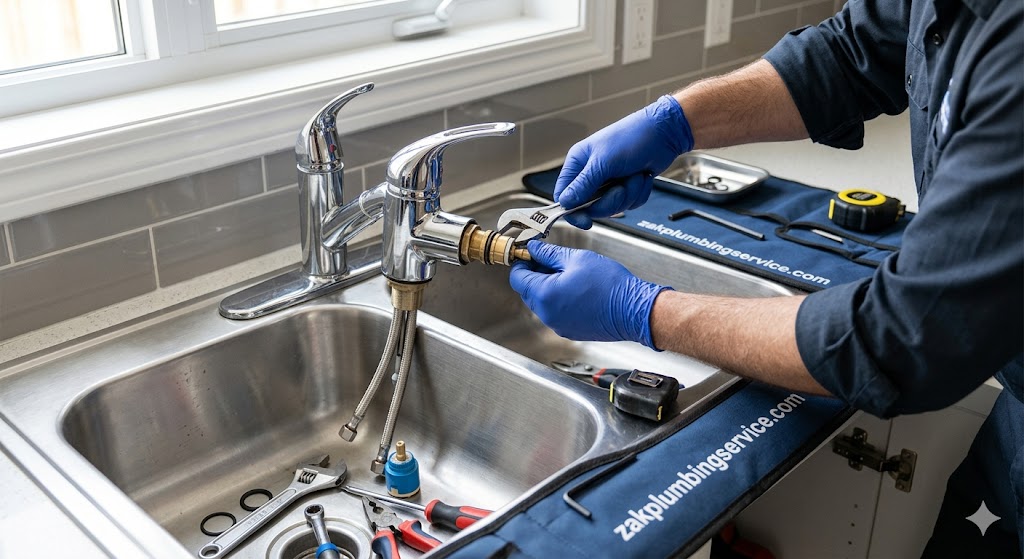
- Use your wrench to remove the packing nut and the stem.
- Replace the washer at the bottom or swap the entire cartridge if it is a cartridge style.
2. Handling Leaks Around the Base
When water pools around the bottom of the faucet where it meets the sink, it usually means an O-ring has failed. This is one of the most common Faucet Repairs we see.
- Disassemble the faucet as described above.
- Look for the rubber O-rings on the body of the faucet.
- Pop them off with a flathead screwdriver.
- Apply a little plumber’s grease to the new ones and slide them on.
3. Cleaning the Aerator
Is your water pressure suddenly low? Before you panic, check the aerator. In 2026, many faucets have high-efficiency aerators that catch tiny bits of sediment.
- Unscrew the aerator from the tip of the spout by hand.
- If it is stuck, use a cloth and pliers to avoid scratching the metal.
- Soak the parts in white vinegar overnight to dissolve mineral buildup.
Troubleshooting Guide for Faucet Repairs
Instead of a complex table, here are the key things to look for when your sink acts up:
- Drip from the nozzle: Usually a worn washer or a damaged cartridge that isn’t sealing properly.
- Leaking handle: Indicates the “packing” or the O-ring around the stem is old and brittle.
- Whistling noise: This often happens when a washer is the wrong size or has come loose inside the stem.
- Erratic spray pattern: Almost always caused by a dirty or clogged aerator.
- Smart sensor not working: Check the batteries first! Most 2026 smart faucets have a battery pack under the sink that needs replacing every 1, 2 years.
When to Call Zak Plumbing Service
While DIY is great, some Faucet Repairs are tricky. If you find yourself staring at a broken pipe, or if the leak persists after you have replaced the cartridge, it might be time to call in the pros. Modern 2026 fixtures can be delicate, especially the touchless models with integrated solenoids.
At Zak Plumbing Service, we have the tools and the experience to get your kitchen or bathroom back in working order without the stress. Don’t let a small drip turn into a flooded cabinet!
How long has your faucet been giving you trouble, or are you just getting ahead of a potential problem?
For More Details Visit Zak Plumbing Service Contact Page