Have you ever walked into your garage or basement and heard a strange, rhythmic thumping coming from your water heater? Or maybe you have noticed that your morning shower feels a bit more “lukewarm” than it used to. If you are like most homeowners, you probably do not think about your How Long Do Water Heaters Last heater until it stops working. But waiting for a complete breakdown is a big mistake.
In 2026, How Long Do Water Heaters Last technology has improved a lot, but the physics of water and metal remains the same. If you do not know the age of your unit or what signs to look for, you could be facing a flooded home and a very expensive bill.
In this guide, I will break down exactly how long these units last in 2026, what the latest industry standards mean for your wallet, and how you can spot a disaster before it happens.
The Big Question: How Long Do Water Heaters Last?
The simple answer depends entirely on the type of system you have in your home. While older models from a decade ago were lucky to hit the ten year mark, modern engineering has pushed these limits slightly. However, the environmental factors like hard water and high usage still play a massive role.
Traditional Tank Water Heaters (8 to 12 Years)
The standard tank How Long Do Water Heaters Last is still the most common choice for many families. These units work by keeping a large volume of water hot all day long. Because they are constantly holding water, they are prone to rust and sediment buildup. In 2026, if your tank is over 10 years old, you are officially in the “danger zone.”
Tankless Water Heaters (15 to 20+ Years)
If you have upgraded to a tankless system, you can breathe a bit easier. These units only How Long Do Water Heaters Last when you turn on the tap. Since they do not store water, there is no tank to rust through. With the latest 2026 descaling technologies, some high end tankless models are now expected to last up to 25 years if they are serviced properly.
Heat Pump Water Heaters (10 to 15 Years)
These are the “green” stars of 2026. They pull heat from the air to warm your water. While they are incredibly efficient, they have more moving parts than a standard electric tank, which means they usually land right in the middle for lifespan.
3 Critical Warnings You Cannot Ignore
If your How Long Do Water Heaters Last is nearing its “retirement age,” it will usually try to tell you. Ignoring these three signs is the fastest way to end up with a “costly failure” that involves a restoration crew and new flooring.
1. The “Pop and Rumble” Sound
If your heater sounds like it is boiling rocks, that is a major red flag. This happens because of sediment buildup at the bottom of the tank. As the water underneath the sediment heats up, it bubbles through the “mud,” creating that banging noise. This doesn’t just waste energy, it actually causes the metal tank to become brittle and eventually crack.
2. Rusty Water or Toilets
If your hot water looks a bit tea colored, but your cold water is clear, your heater is rusting from the inside out. There is no “fixing” a rusted tank. Once the internal lining is gone, a leak is inevitable. In 2026, we see this often in homes that have never replaced their anode rod (the “sacrificial” part that prevents rust).
3. Moisture Around the Base
Any amount of water around the bottom of your heater is a “Code Red.” It might look like a small “sweat” or a tiny drip, but metal expands when it is hot. A small drip today can become a literal flood tomorrow.
Important Factors for Water Heater Longevity in 2026
To help you understand where your unit stands, here is a breakdown of what influences the lifespan of your system.
- Water Quality: If you live in an area with “hard water,” minerals like calcium will build up inside your unit twice as fast. In 2026, many homeowners are installing “scale prevention” filters to double their heater’s life.
- The Anode Rod Status: This is a magnesium or aluminum rod inside the tank. Its only job is to rust so your tank doesn’t. If you replace this every 3 to 5 years, your tank can last much longer than the average.
- Temperature Settings: If you keep your heater set to 140°F or higher, you are actually speeding up the corrosion process. Keeping it at 120°F is the “sweet spot” for both safety and equipment health.
- Usage Demand: A small 40 gallon tank serving a family of six is going to burn out much faster than a properly sized unit. Constant “reheating” cycles wear out the heating elements and the tank itself.
- 2026 Efficiency Standards: New Department of Energy rules starting in late 2026 mean that many older, inefficient models are being phased out. If you replace your unit now, you will likely have to get a “condensing” or “heat pump” model which lasts longer but requires different maintenance.
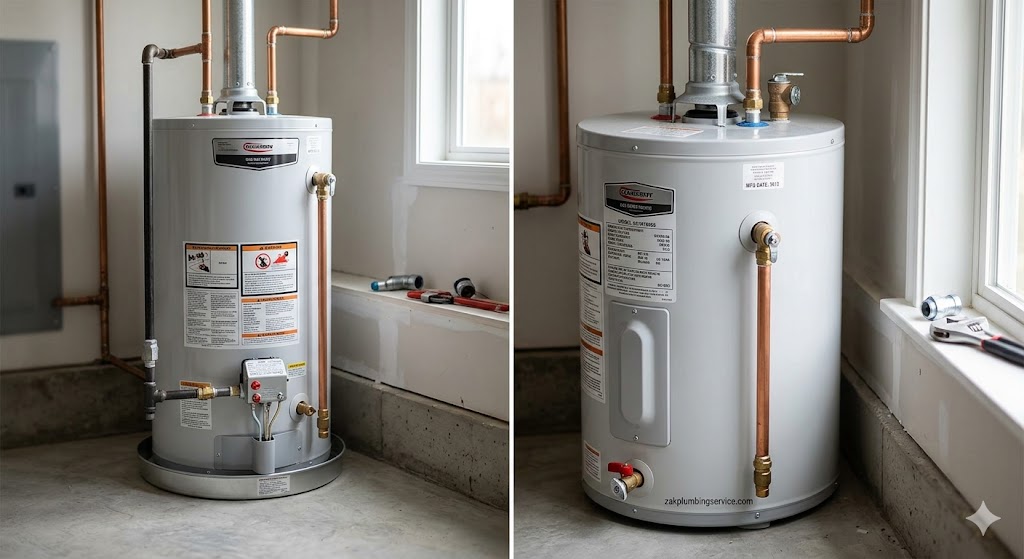
How to Extend the Life of Your Unit (The 2026 Checklist)
You don’t just have to wait for it to die. You can take action. Here is the routine we recommend for all our customers at Zak Plumbing Service.
Annual Flushing
Once a year, you should drain a few gallons of water from the bottom of the tank. This removes the “sand” and sediment that builds up. For tankless units, this involves a “descaling” flush with a vinegar solution.
Check the Pressure Relief Valve
This is the little lever on the side or top. It is designed to stop your How Long Do Water Heaters Last from becoming a rocket if the pressure gets too high. Testing it once a year ensures it isn’t “stuck” shut.
Professional Inspection
Every 2 years, have a pro look at it. We can check the electrical connections, the gas thermocouple, and the state of the internal lining. A $100 inspection is much cheaper than a $3,000 emergency replacement on a Sunday night.
Final Thoughts
Knowing “how long do water heaters last” is the first step in being a smart homeowner. In 2026, we have better tools than ever to keep these systems running, but they are not immortal. If your tank is over 10 years old and you hear those “thumping” noises, do not wait.
Call a professional to take a look. It is much easier to plan a replacement on your own schedule than to deal with a cold shower and a flooded basement during a holiday weekend. Keep an eye on those “critical warnings,” and you will save yourself a lot of money and stress.