Finding water pooling around your appliances is never a good sign. If you notice your Water Heater Leaking, it is important to act fast.
A small drip today can turn into a flooded basement tomorrow, leading to expensive floor repairs and mold growth. In 2026, we have more tools than ever to catch these issues early, but the basics of plumbing still apply.
Most homeowners panic when they see water, but stay calm. Sometimes the “leak” is just condensation, especially in humid weather.
However, if it’s a steady stream, you need to follow a few simple steps to protect your home.
This guide will walk you through the most common causes and the best ways to fix them before things get out of hand.
Why is My Water Heater Leaking? Identifying the Culprit
Before you can fix the problem, you have to find where the water is coming from. Start by wiping up the existing puddle and watching closely with a flashlight. Is it dripping from a pipe at the top, or is it seeping out from under the tank?
A Water Heater Leaking can be caused by something as simple as a loose valve or as serious as a cracked internal tank.
In 2026, many newer units come with built-in diagnostic screens that might even give you an error code. If you don’t have a “smart” heater, you’ll have to do a bit of old-fashioned detective work.
Checking for a Water Heater Leaking from the Top
If you see moisture on the top of the unit, the fix might be easier than you think. Often, the cold water inlet or hot water outlet pipes have loose connections.
Over time, the constant heating and cooling causes pipes to expand and contract, which can loosen the fittings.
Another common reason for a Water Heater Leaking from the top is a corroded nipple (the small pipe segment connecting the tank to the lines).
If these look rusty or crusty, they probably need a quick replacement. It’s much cheaper to fix a pipe than a whole tank!
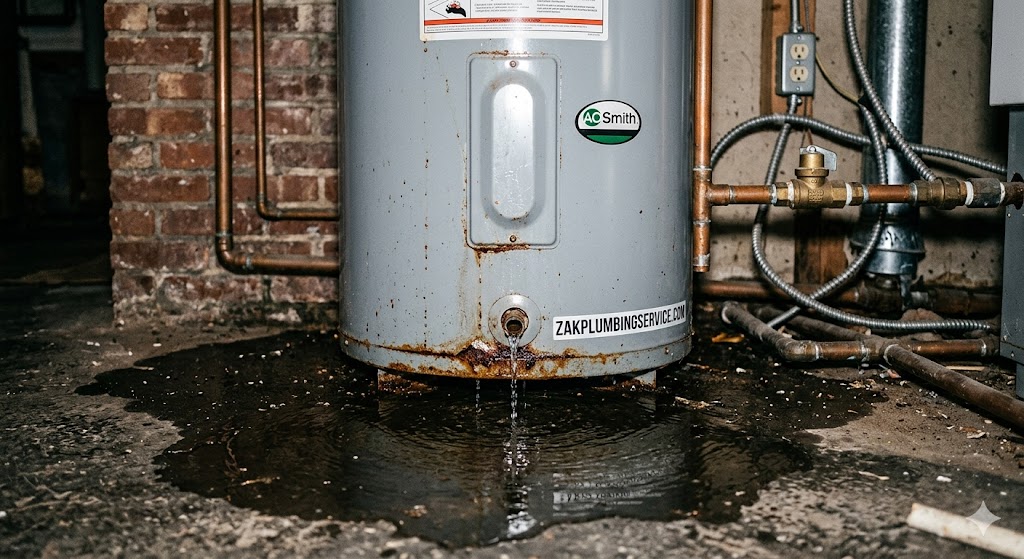
Detecting a Water Heater Leaking from the Bottom
Seeing water at the base of the unit is usually more concerning. This often points to an issue with the drain valve or, unfortunately, internal tank corrosion.
If the internal lining of the tank has cracked, the water will eventually find its way through the insulation and out the bottom.
In many cases, a Water Heater Leaking from the bottom means the unit has reached the end of its life. Most tanks last about 8 to 12 years. If yours is a “senior citizen” in the appliance world, it might be time to look at those new 2026 high-efficiency models.
10 Essential Solutions for a Water Heater Leaking
- Tighten Loose Connections: Use a pipe wrench to gently tighten the nuts on the inlet and outlet pipes. Don’t overdo it, or you might crack the fitting.
- Replace the T&P Valve: The Temperature and Pressure relief valve is a safety feature. If it’s dripping, it might be faulty. Replacing this is a standard, affordable fix.
- Flush the Sediment: Build-up of minerals at the bottom can cause the tank to overheat and leak. Draining and flushing the tank once a year keeps it healthy.
- Check the Drain Valve: This is the plastic or brass spout at the bottom. If it doesn’t close all the way, you can replace it with a more durable brass version.
- Lower the Temperature: If your water is too hot, the pressure builds up too much. Keep your heater set to 120°F (49°C) to reduce stress on the tank.
- Replace the Anode Rod: This “sacrificial” rod attracts rust so your tank doesn’t. If you haven’t checked it in 3 years, it’s probably gone, leaving your tank vulnerable.
- Install an Expansion Tank: If your home has a closed plumbing system, an expansion tank gives extra water a place to go when it heats up, preventing leaks.
- Repair the Pipe Nipples: If the leak is at the very top entrance of the tank, replacing the galvanized nipples can stop the drip instantly.
- Check Water Pressure: Use a gauge to ensure your home pressure is under 80 PSI. High pressure is a leading cause of a water heater leaking.
- Replace the Unit: If the tank itself is leaking from a crack, there is no safe way to “patch” it. Replacing the unit is the only permanent solution to avoid a flood.
Water Heater Solution Quick Guide (Data Points)
Instead of a table, here are the key takeaways regarding repair costs and parts for 2026:
- Average Professional Repair Cost: In 2026, most repairs range between $220 and $1,000 depending on the part.
- Replacement Cost: A full tank replacement usually falls between $1,600 and $2,400, including labor and permits.
- DIY Difficulty: Tightening connections is a Level 1 (Easy) task, while replacing a T&P valve is a Level 3 (Intermediate).
- Anode Rod Lifespan: These should be inspected every 2 to 3 years to prevent tank failure.
- Top Leak Cause: Most top-side leaks are due to loose fittings or corroded supply lines.
- Bottom Leak Cause: Most bottom leaks are due to sediment buildup or a faulty drain valve.
The 2026 Tech Update: Smart Sensors and AI Prevention
The biggest change we’ve seen in 2026 is the rise of AI-powered leak detection. Many new systems now use acoustic sensors that “listen” for the sound of a pinhole leak before you ever see water on the floor.
If you have an older unit, you can still buy “Smart Leak Detectors” that sit on the floor and alert your phone the second they get wet.
Some of these 2026 systems even include an automatic shut-off valve. If a Water Heater Leaking is detected, the system automatically turns off the water supply to the heater.
This can save you thousands of dollars in water damage, making it a very smart investment for any homeowner.
Maintenance Tips to Prevent a Water Heater Leaking
The best way to handle a leak is to never have one in the first place. A little bit of love goes a long way. Make it a habit to walk past your heater once a month just to check for any weird smells or damp spots.
Also, don’t forget to test your T&P valve twice a year. Just lift the lever briefly to make sure water flows out and stops when you let go. If it keeps dripping after the test, it’s time for a replacement. Regular maintenance is the secret to making your heater last 15 years instead of 8.
When to Call Zak Plumbing Service for a Water Heater Leaking
Sometimes a DIY fix isn’t enough, especially when dealing with gas lines or high-voltage electricity. If you’ve tried tightening the valves and the water is still coming, don’t risk a DIY disaster.
At Zak Plumbing Service, we specialize in diagnosing and fixing a Water Heater Leaking quickly and affordably. Whether you need a simple part replacement or a brand-new energy-efficient installation, our team is here to help.
Don’t wait for the puddle to become a pond, give us a call today and let’s get your hot water back on track!