By now, almost every plumber and DIY fan knows that PEX is the gold standard for home water lines. It doesn’t rust like galvanized steel, and it won’t pinhole leak like old copper pipes. But as we move through 2026, the debate isn’t about whether to use PEX, but rather which type to choose. Selecting between PEX A vs PEX B can feel like a toss-up, but making the wrong choice for your specific project can lead to leaks, low water pressure, or even a total system failure.
Understanding the Core Differences: PEX A vs PEX B
To make a smart choice, you first have to understand that these aren’t just different brand names, they are actually made differently at the molecular level.
How PEX A vs PEX B are Made
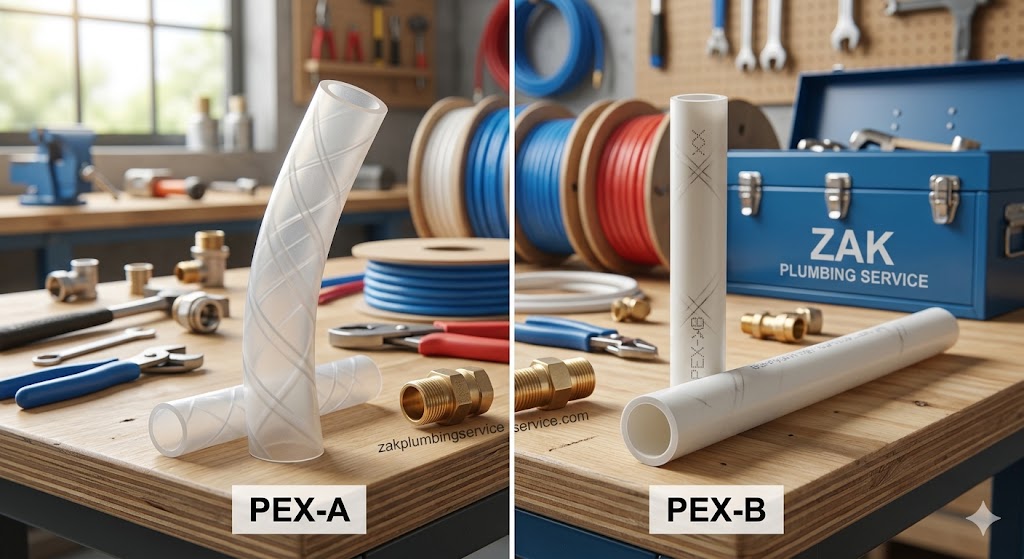
PEX A is created using the “Engel” method. This process cross-links the molecules while the polyethylene is still in its liquid state. The result? A pipe that is incredibly flexible and has “thermal memory,” meaning if it kinks, you can actually fix it with a heat gun. On the other side, PEX B is made via the “Silane” method. This cross-linking happens after the pipe is extruded. It makes for a slightly stiffer pipe that is very strong and resistant to high chlorine levels, which is a big plus for city water systems in 2026.
The 3 Costly Mistakes in PEX A vs PEX B Installation
Even the best materials won’t save a bad install. Here are the three most common blunders we see in the field that end up costing homeowners thousands.
Mistake 1 – Mixing Tools and Fittings
This is the most common error. PEX A uses “expansion” fittings. You use a tool to stretch the pipe and a sleeve, slide it over the fitting, and let it shrink back down. PEX B, however, almost always uses “crimp” or “clamp” rings. We often see people trying to use PEX B pipe with expansion fittings, but PEX B doesn’t have the “memory” to shrink back properly. This creates a weak seal that might hold for a week but will eventually blow off, causing a massive flood.
Mistake 2 – Ignoring Environmental Factors
In 2026, water treatment has become more aggressive. PEX B actually has a higher resistance to chlorine than many types of PEX A. If you live in an area with highly treated city water and you install a lower-grade PEX A, you might see the pipe degrade faster over 20 or 30 years. Also, neither pipe likes the sun. Leaving your PEX rolls out in the driveway for a week before the install can weaken the plastic significantly due to UV exposure.
Mistake 3 – Improper Bending and Support
Because PEX A is so flexible, people get lazy with supports. Even though it can bend around corners, you still need to secure it every 32 inches to prevent “water hammer” (that banging sound in the walls). With PEX B, the mistake is usually forcing a bend that is too tight. If you force PEX B into a sharp 90-degree turn without a fitting, you’ll create a “stress crack” that will eventually fail.
Comparison Breakdown: PEX A vs PEX B Features
Here is a quick look at how these two stack up against each other in real-world scenarios.
- Flexibility Performance: PEX A is the clear winner here. It is much easier to snake through old walls during a remodel. PEX B is stiffer and often requires more elbow fittings to make the same turns.
- Pipe Repairability: If you accidentally kink a PEX A pipe, you can usually heat it up and it returns to its original shape. If you kink PEX B, you have to cut that section out and install a coupling.
- Water Flow and Pressure: Because PEX A expansion fittings are the same diameter as the pipe itself, you get better water flow. PEX B crimp fittings sit inside the pipe, which slightly narrows the opening and can lead to a small drop in pressure if you have dozens of fittings in a row.
- Freeze Resistance: PEX A can expand much more than PEX B. If your pipes freeze in the winter, PEX A is far less likely to burst. PEX B is still better than copper, but it can crack under extreme ice pressure.
Cost and Value in 2026
Budget is always a factor. Generally, PEX B is about 25% to 35% cheaper than PEX A. However, you have to look at the total “system cost.” Because PEX A is more flexible, you buy fewer fittings. Since every fitting is a potential leak point, some homeowners find the extra cost of PEX A is worth the peace of mind. For a standard 2,000-square-foot home in 2026, the price difference for materials usually sits between $300 and $600.
Finally
So, which one wins the PEX A vs PEX B battle? If you are doing a DIY project on a budget and want tools you can find at any hardware store, PEX B is a fantastic, reliable choice.
But if you are doing a full home remodel or live in a place where the ground freezes, the flexibility and “forgiving” nature of PEX A makes it worth the investment. Just remember, no matter which one you pick, use the right tools for the job!
Is your home’s plumbing ready for a 2026 upgrade, or are you still relying on aging copper pipes?
For More Details Visit Zak Plumbing Service Contact Page